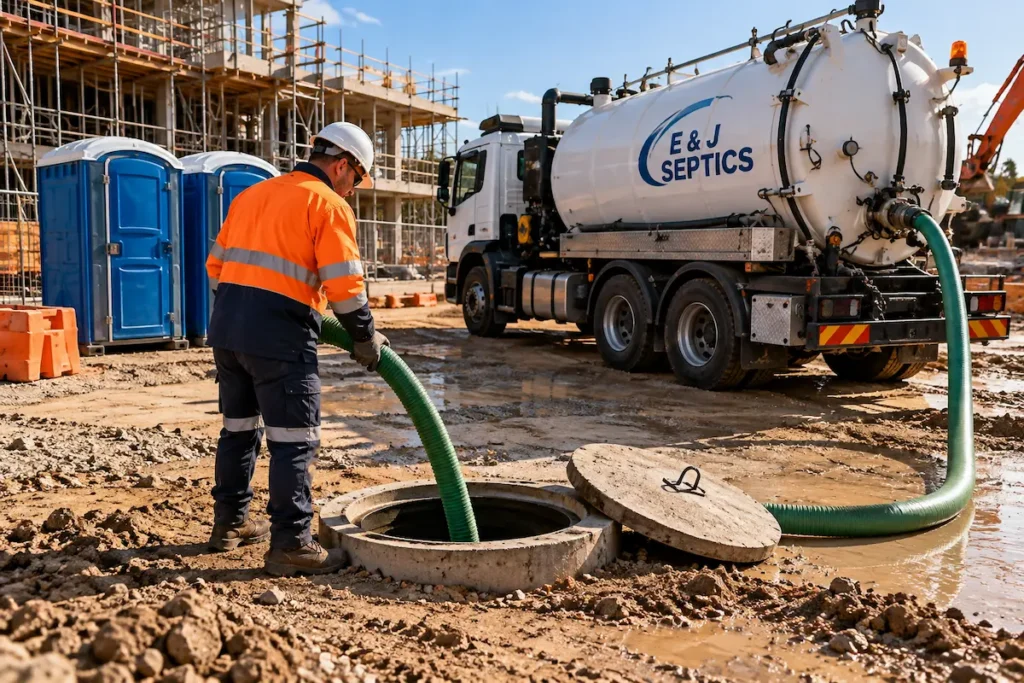
Construction sites generate more than piles of timber, concrete, packaging and demolition material. Behind the obvious solid waste, there can be another waste stream that needs just as much attention: wastewater and other liquids collecting around the site.
Temporary amenities need servicing. Holding tanks fill. Pump pits collect water. Excavations can encounter groundwater. Heavy rain can leave sediment-filled water that needs to be dealt with before work can continue.
For builders and site managers, liquid waste management is therefore something worth planning early rather than dealing with only when a tank is full or water starts getting in the way.
E & J Septics provides construction site waste removal Melbourne services for projects requiring portable toilet servicing, holding tank pump-outs, pump pit servicing and other construction-related waste management.
Understanding where liquid waste is likely to come from and how it will be removed, can make day-to-day site management considerably easier.
Where Does Liquid Waste Come From on a Construction Site?
There is no single source of construction wastewater.
The type and volume can change as a project moves from excavation and groundwork through to construction and fit-out. A site might have relatively little wastewater one week and require substantial removal capacity the next.
Common requirements can include holding tanks, portable toilets, pump pits, groundwater and other wastewater associated with construction and major projects. For projects producing larger volumes, E & J also provides construction liquid waste removal Melbourne services designed for major-project requirements.
That means construction wastewater removal needs to suit the actual site rather than relying on a one-size-fits-all approach.
Site Holding Tanks
Temporary holding tanks are common where permanent sewer connections are unavailable or not yet ready for use.
The challenge is simple: the tank has a limited capacity.
As site activity increases, so does the amount of wastewater entering it. Waiting until a tank is approaching capacity can turn a routine service into an urgent problem.
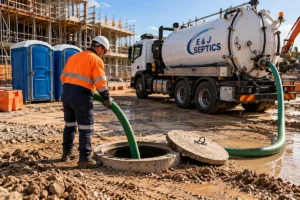
E & J’s construction site service includes emptying septic holding tanks. Scheduled removal can help site teams manage capacity before it becomes an operational problem.
For longer projects, arranging servicing around expected usage gives the site team one less issue to manage at short notice.
Temporary Wastewater Systems
Construction projects regularly rely on temporary infrastructure while permanent services are being installed.
That can create wastewater from site amenities, temporary sanitary facilities and other project activities. Major construction work can also produce groundwater, runoff and other liquid waste streams that need to be assessed and appropriately managed.
EPA Victoria provides specific guidance on preventing stormwater pollution on building sites, including controls for sediment, concrete washout and other liquids.
The important point is that temporary does not mean unplanned.
Site managers should know where wastewater is being collected, approximately how quickly storage is filling and who is responsible for arranging removal.
Portable Toilets Need More Than Delivery
Portable toilets are an everyday part of Melbourne construction sites, but putting them in place is only the beginning.
Waste still needs to be pumped out, and the units need ongoing cleaning and servicing to remain usable throughout the project.
E & J Septics provides site liquid waste services Melbourne projects can use for portable toilet waste removal, cleaning, sanitising and ongoing servicing.
WorkSafe Victoria’s guidance on portable toilets on worksites states that portable toilets should be serviced regularly. Its guidance covers pumping and rinsing sewage storage tanks, cleaning and disinfecting the unit, replenishing supplies and maintaining the toilet in a hygienic condition.
Where toilets or waste tanks also need to be moved between areas or projects, E & J Septics provides portable toilet transportation for construction sites using specialist transport equipment.
Servicing frequency should reflect actual site usage. A small crew and a large workforce will place very different demands on the same number of facilities.
Changes in workforce numbers are therefore a good reason to review the servicing schedule rather than simply continuing with the original arrangement.
Pump Pits and Accumulated Site Water
Water collecting in pits can quickly become an operational issue.
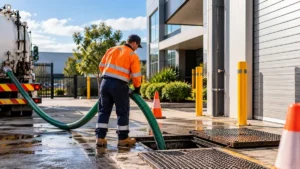
E & J Septics liquid waste management construction sites service includes pump pits used for stormwater, sewage and excess groundwater.
Pump pits can require attention after rainfall, during excavation or whenever water is accumulating faster than the site’s existing system can manage it.
This is one area where scheduled servicing can be useful while still allowing the site team to respond when conditions change unexpectedly.
Sediment and Water Removal After Rain or Excavation
Not every water problem arrives on a predictable timetable.
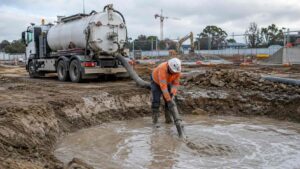
Excavation can expose groundwater, while rain can leave water mixed with sediment or other site contaminants.
EPA Victoria identifies sediment from building and construction sites as a source of stormwater pollution and advises construction sites to plan controls that prevent sediment from leaving the site.
For more detailed environmental guidance, site managers can refer to EPA Victoria’s Civil construction, building and demolition guide. The guide covers environmental risk management for civil construction, building, demolition, earthworks and related activities.
Before arranging construction wastewater removal, the waste stream needs to be properly understood. Different liquids can require different handling and disposal methods, so the waste contractor needs accurate information about what has collected and where it has come from.
For site managers, the practical lesson is straightforward: don’t assume every pool of water on a construction site should be treated the same way.
Why Truck Capacity Matters on Larger Construction Projects
A small wastewater job and a major construction project can require very different equipment.
If a site is producing significant volumes, using equipment suited to bulk removal can reduce the number of loads and help keep servicing practical.
E & J Septics’ fleet includes 12,000-litre heavy rigid vacuum trucks used for applications including large waste holding tanks. The business also operates a 24,000-litre semi-trailer for bulk waste applications including major construction projects.
Multiple 12,000-litre trucks can also be used alongside the semi-trailer when larger-volume removal is required.
At the other end of the scale, access can be more important than capacity.
E & J Septics also operates an 8,000-litre medium rigid vehicle and a purpose-built 2,100-litre restricted-access truck with a maximum height of 2.05 metres. The smaller unit is designed for locations including underground car parks, pump pits and restricted job-site access.
For site liquid waste services in Melbourne, matching the vehicle to the job is therefore about more than simply sending the biggest truck available. Waste volume, access, hose reach and the physical layout of the site all matter.
Scheduled Servicing or Call When the Tank Is Full?
For an active construction project, scheduled servicing provides a more organised way to manage predictable waste streams.
Holding tanks and portable toilets are good examples. If usage is reasonably consistent, the site can establish a service interval and adjust it when workforce numbers or site conditions change.
A practical servicing plan might consider:
- expected wastewater volume
- holding tank capacity
- number of portable toilets
- number of workers using the facilities
- site operating hours
- truck access
- changing project stages
- weather and site conditions that could increase water accumulation
The schedule does not need to remain fixed for the entire project.
Early works, excavation, peak construction and final stages can create very different liquid waste requirements. Reviewing the plan as the project changes can help avoid both unnecessary servicing and tanks being left too long.
What About Emergency Liquid Waste Removal?
Even well-planned sites can have unexpected requirements.
A holding tank may fill faster than anticipated. Heavy rain may create additional water. A pump pit may need urgent attention. Site access or project scheduling can also change with little warning.
E & J Septics states that emergency waste management services are available for urgent construction-site requirements.
When requesting urgent assistance, providing clear information can help the waste contractor understand what is required before arriving.
Useful details include the type of liquid, estimated volume, where it is located, access restrictions and whether the problem is affecting current site operations.
Planning Liquid Waste Management Before It Becomes a Problem
Good liquid waste management for construction sites starts with identifying the likely waste streams before they become urgent.
For a new project, that can mean answering a few practical questions:
What temporary wastewater systems will be used?
Where are the holding tanks located?
How will portable toilets be serviced?
Are pump pits likely to collect groundwater or stormwater?
Can vacuum trucks access the required areas?
How much waste could need to be removed at peak periods?
Does the project require regular servicing, large-volume removal or both?
Answering those questions early gives the site team a clearer picture of what equipment and servicing schedule may be required.
It can also help avoid the situation where liquid waste is only considered once it starts interfering with the job.
Construction Liquid Waste Removal in Melbourne: One Plan, Different Requirements
There is rarely just one liquid waste requirement across an entire construction project.
A site may begin with excavation water, move to temporary wastewater and holding tanks, require ongoing portable toilet servicing throughout the build and need pump-pit or sediment-filled water removed as conditions change.
That is why construction liquid waste removal in Melbourne is best approached as an ongoing site requirement rather than an isolated pump-out.
E & J Septics provides construction site waste management alongside major-project liquid waste removal, with equipment ranging from restricted-access vehicles through to high-volume vacuum trucks and a 24,000-litre semi-trailer.
For builders and site managers, the objective is simple: know what liquid waste the project is generating, where it is being contained and how it will be removed before capacity or site conditions create a problem.
Frequently Asked Questions
What types of liquid waste can occur on Melbourne construction sites?
Depending on the project, construction sites can generate temporary sanitary wastewater, portable toilet waste, holding tank waste, excavation groundwater, sediment-contaminated water and other project-related liquid waste.
The exact waste stream should be identified before collection so the appropriate removal and disposal method can be determined.
Can construction site liquid waste removal be scheduled?
Yes. E & J provides ongoing servicing for construction-site requirements including holding tanks, portable toilets and pump pits. The appropriate schedule depends on factors such as waste volume, storage capacity, site usage and access.
Can large volumes of construction wastewater be removed?
E & J operates high-volume equipment including 12,000-litre heavy rigid vacuum trucks and a 24,000-litre semi-trailer suited to bulk waste applications and major projects.
What if a vacuum truck cannot easily access the waste?
Access should be discussed when arranging the service. E & J’s fleet includes different vehicle sizes, including an 8,000-litre medium rigid truck and a 2,100-litre restricted-access vehicle designed for locations such as underground car parks and restricted job sites.
Does E & J provide urgent liquid waste removal?
E & J states that emergency waste management services are available for urgent construction-site requirements. Providing the waste type, estimated volume and site-access information when calling can help the team understand the requirement.
Need Help Planning Liquid Waste Removal for a Melbourne Construction Site?
If your project involves holding tanks, temporary wastewater, portable toilets, pump pits or larger volumes of construction wastewater, planning servicing early can make ongoing site management much simpler.
E & J Septics provides construction wastewater removal and construction site waste management across Melbourne, with equipment available for restricted-access and bulk-volume requirements.
You can also check E & J Septics liquid waste service areas across Melbourne and regional Victoria before discussing the requirements of your project with the team.